European Land Robot Trial (ELROB) 2026: Robotics for security-relevant operations
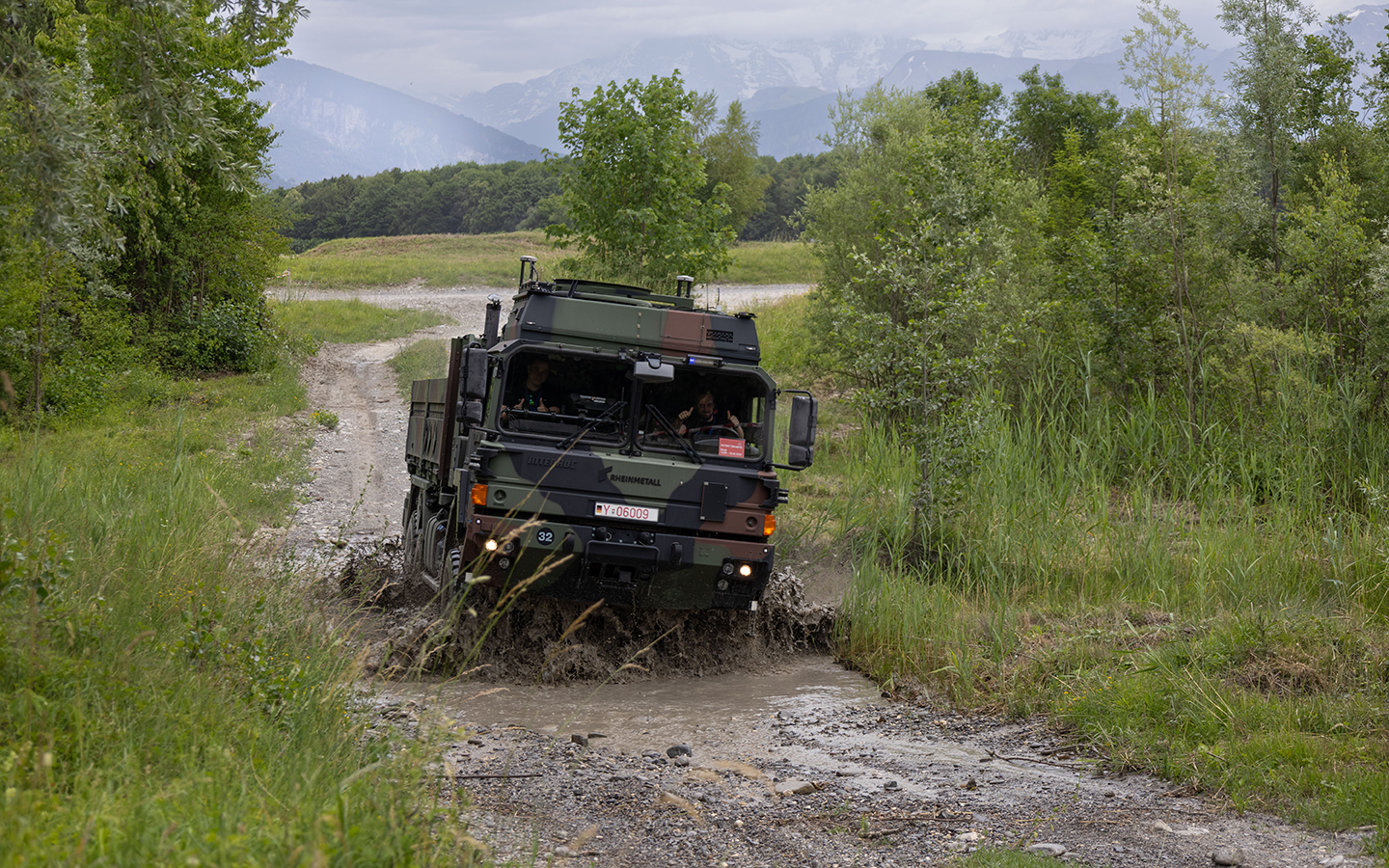
Bern, 15.06.2026 — From 15 to 19 June 2026, armasuisse Science and Technology (S+T) will be host to the European Land Robot Trial (ELROB), in cooperation with the Fraunhofer FKIE from Germany and RUAG AG. Over four days, the Military Training Area in Thun will become the setting for deploying land robots in realistic military and civilian scenarios. ELROB is the most established event of this kind in Europe.
The event is internationally oriented and will focus on unmanned land vehicles. ELROB 2026 is the 13th occasion of the event and is now taking place in Switzerland for the second time. The host country rotates between the German-speaking countries of Germany, Austria and Switzerland. The event takes place every two years. The Thun Military Training Area as this year’s venue, with an expanse of around 6.5 square kilometres, is both the largest as well as the oldest of its kind in Switzerland, and offers ideal conditions for this purpose.
Performance comparison of robotics during realistic scenarios
ELROB’s objective is to have a direct influence on practical applications by realistically demonstrating innovative robotics technology – for example, in the area of life-saving measures. In order for new technologies from research and development to be put into practice, it must be possible to test them under realistic conditions. The focus will be on robotic systems that can be implemented quickly, so that the current state of the art can be assessed and at the same time specific challenges from practice can be addressed.
Robotics systems from more than 20 international teams in the suitability test
More than 20 international teams have the opportunity to test their robotic systems in realistic scenarios and have them assessed by a jury based on their performance. What makes ELROB special is that it is not a competition but rather a trial or a suitability test. The goal is to demonstrate what European and international robotics is currently capable of doing.
Robotics in the military endurance test
Five realistic, military scenarios take place at the ELROB:
Transport – Convoying
The transport of persons, materials and humanitarian aid are some of the routine tasks of many operations by security authorities. However, in hostile environments, these transports are particularly hazardous, as convoys are often the target of attacks. In this scenario, at least two vehicles have to reach a destination. Each vehicle should be able to transport a payload of at least 1,500 kg. Only one of the vehicles is manned. Both vehicles should reach the destination as fast as possible and with as much autonomy as possible.
Reconnoitring of a non-urban environment
Reconnaissance of non-urban areas is a key requirement for military operations. At the same time, it is one of the most dangerous tasks for soldiers. The use of robots to reconnoiter potentially dangerous areas can thus considerably protect and relieve the forces. In this scenario, the systems reconnoiter an environment with numerous obstacles and create a two-dimensional or three-dimensional map (2D/3D) of the terrain.
Transport – Mule
Soldiers have to carry increasing amounts of heavier equipment on foot in the field. This additional load impedes their mobility, distracts them from their actual tasks and leads more rapidly to fatigue. Robotic systems can provide valuable support here. In the scenario, the systems follow a person and cover a distance of around 300 metres.
Search & Rescue (SAR)/CasEvac
The rescue and recovery of injured persons is one of the most important and simultaneously demanding tasks, both in civil disasters as well as in military operations. In military operations, evacuation (CasEvac) frequently takes place in hostile environments, while in civil disasters, it is often in difficult and precarious terrain. The deployment of robotic vehicles for localising, collecting and transporting injured persons reduces the risks for task forces in such situations.
Reconnaissance of explosive remnants of war (ERW)
The reconnaissance of terrain and infrastructures in areas with remnants of war, both in rural and in urban regions, is a demanding task. This includes vehicle inspection as part of threat prevention. Systems must reliably detect and identify potentially dangerous objects in the scenario.
Unmanned systems are gaining in security-relevant significance
The security situation has intensified. In parallel, a rapid development and military anticipation of technologies is taking place. In this context, it is clear that unmanned systems and their automation are becoming increasingly significant. Particularly in urban and asymmetric deployment scenarios, unmanned systems can reduce risks for task forces and strengthen existing capabilities as well as create potential new applications.
This is where armasuisse Science and Technology’s research becomes involved. Researchers develop innovative technological solutions and test various systems under realistic conditions. The goal is to identify new technologies early on, evaluate them from a scientific perspective and make them usable for security-relevant applications. In this context, the Swiss Drone and Robotics Centre of the DDPS (SDRC DDPS) is implementing the research programme “Unmanned systems/robotics” as part of the policy research. The focus is on developing promising civilian robotic solutions from research and innovation more rapidly and putting them into security-relevant practice. A key element for this is practical testing.
- ELROB 2026
- ELROB.org
- Robotics for security-relevant operations
- “ELROB is undoubtedly the hub of unmanned military land robotics in Europe” – Interview with Dr. Frank Schneider, founder of ELROB
- A tool for better understanding robotic systems – an interview with Dr. Markus Höpflinger and Joseph Boucher from the Swiss Drone and Robotics Centre